As we mark the first full year of the Rere ki uta rere ki tai – Living Soil Project, we are taking a moment to reflect on how far we have come and what we have learned along the way.
Our kaupapa continues to connect people, place, and practice, weaving together science, Mātauranga Māori, and farmer knowledge to restore the mana and mauri of our soils.
Our Growing Network
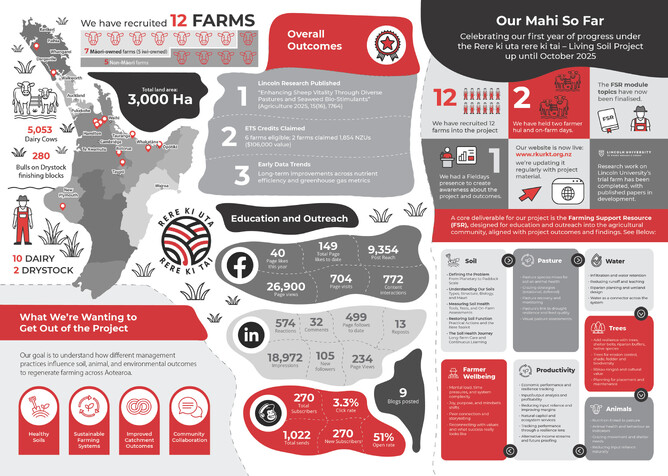
This year, we welcomed 12 farms into the project, including 7 Māori-owned (5 iwi-owned) and 5 non-Māori farms, representing more than 3,000 hectares of land and over 5,000 dairy cows across Waikato, Bay of Plenty, and beyond.
Each farm is on its own journey of transformation, trialling practical changes to improve soil health, productivity, and resilience. Together, they are helping us understand how different land management approaches influence soil, animal, and environmental outcomes across Aotearoa.
What We Have Achieved
Two farmer hui and on-farm days held, connecting participants and sharing on-the-ground progress.
Research at Lincoln University completed, with publications now underway on the benefits of diverse pastures and seaweed biostimulants.
Presence at National Fieldays to increase awareness of the project and its outcomes.
Launch of the Farming Support Resource (FSR) module, a key educational tool designed to help farmers transition to more resilient systems.
New website live at www.rkurkt.org.nz, providing ongoing updates, blogs, and learning resources.
Progress in Practice
Across our project farms, we are already seeing measurable shifts:
Reduced nitrogen use across multiple farms, with several achieving 30–70 percent reductions from their baselines.
Increased use of biological inputs such as seaweed biostimulants, fish hydrolysate, and effective microorganisms.
Diverse pasture establishment growing from near zero to as much as 100 percent of the effective dairy area on some farms.
Deferred grazing introduced on 27 hectares across two farms to support soil recovery and biodiversity.
Riparian planting and shelterbelt trees established across multiple sites, protecting waterways and supporting animal welfare.
Land use capability mapping completed for 9 of the 12 farms, helping guide smarter, place-based decisions for future planting and production.
Early Signs of Impact
Early data trends are showing encouraging results:
Improved nutrient efficiency and reductions in greenhouse gas emissions.
Stronger profitability on transitioning farms, with some seeing more than a 30 percent lift in total revenue and significant gains in operating profit.
Two farms successfully claiming ETS credits, recognising their contribution to carbon sequestration and landscape restoration.
Mātauranga Māori and Place-Based Learning
Workshops held this year have brought Te Ao Māori principles to the forefront of our learning. Farmers participated in the Pūnaha Akoako framework wānanga and engaged with kaupapa such as maramataka, rongoā, and soils from a Te Ao Māori perspective. These learnings have deepened understanding of connection and balance, reinforcing that when the land is well, the people are well.
Looking Ahead
The foundation has been laid. Over the next year, we will continue monitoring progress through our soil testing and farm assessments, tracking changes in biological function, nutrient efficiency, and profitability.
We will also expand our education and outreach, building more tools and workshops through the Farming Support Resource to share learnings with the wider agricultural community.
Together, we are proving that when we care for the soil, everything connected to it thrives, from the mountains to the sea.