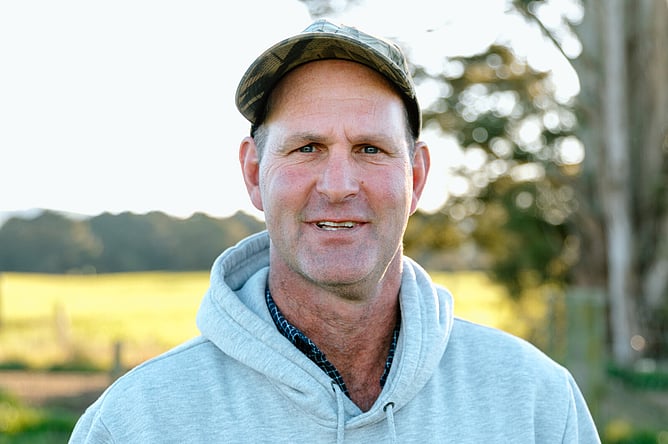
Located in Reporoa, about halfway between Taupō and Rotorua and bordering the Waikato River, Omahanui Farm is owned and operated by Rhys and Pen Bullock.
Like many farmers, Rhys had stepped away from farming groups and industry networks for a period of time. When the opportunity arose to join the Rere ki uta rere ki tai - Living Soil Project, he saw it as a chance to reconnect with a community of farmers who shared similar values and aspirations.
"I was stoked to be able to join a group of like-minded people that really had similar goals. A group like this is hard to find."
The project focuses on supporting farmers to explore practices that enhance the health and resilience of their soils, farming businesses and wider landscapes. For Rhys and Pen, it has provided an opportunity to re-engage with practices they had been passionate about for many years.
Over the past season, they have reintroduced multi-species cropping and renewed their enthusiasm for incorporating greater species diversity into their pastures. They have also restarted their planting programme and begun incorporating areas of the farm into the Emissions Trading Scheme (ETS). There has also been a renewed push to raise the base fertility of the farm which has some very low levels.
"We have got back into multi-species cropping and got enthusiastic again about trying to introduce more species into our pastures. We have also got back into our planting programme and have got some compartments into the ETS. Finding a way to raise our fertility with the use of Seaphos has also seen pasture production gains, while not damaging our existing biology that we have spent a long time building"
Rhys and Pen have always farmed Omahanui under biological principles but for the past couple of years they have taken their foot off the pedal in regards to multispecie cropping and trying to get more diversity into their pastures. While it is still early days since returning to these practices, Rhys says they have not yet noticed significant changes on-farm.
"We haven't really noticed any changes as we have only got back onto this track for the last season."
Unlike many farm transitions, Rhys says there haven't been any major challenges along the way.
"No real challenges. We have been on this path for many years, just stalled a bit."
For him, one of the most rewarding aspects of being involved in the project has been the people.
"Being with like-minded people and feeding from their enthusiasm."
The connections, conversations and shared learning opportunities have helped reinforce the Bullocks' commitment to continuing their journey and exploring new ideas on-farm.
When asked what he would say to another farmer considering joining a project like Rere ki uta rere ki tai, Rhys believes it ultimately comes down to mindset.
"The traditional side of our industry is very entrenched and to go down this path is running a little against the grain. From my perspective it certainly doesn't happen overnight. It takes time and patience, but it is very rewarding and gives you a better connection with your land and soil."
His advice for others looking to make positive changes is straightforward.
"Get into it."
Looking ahead, Rhys is excited about what the future holds for Omahanui Farm.
"There's actually a lot going on on-farm that I'm excited about. Breeding, back into the multi-species cropping and the planting, and getting some recompense for it through the ETS."
For Rhys and Pen, the journey is not about making overnight changes. It is about continually building on what they know, learning from others, and creating a farming system that works for their land, their business and their future.
Their story is a reminder that meaningful change often starts with reconnecting to what inspired you in the first place and surrounding yourself with people who share that vision.