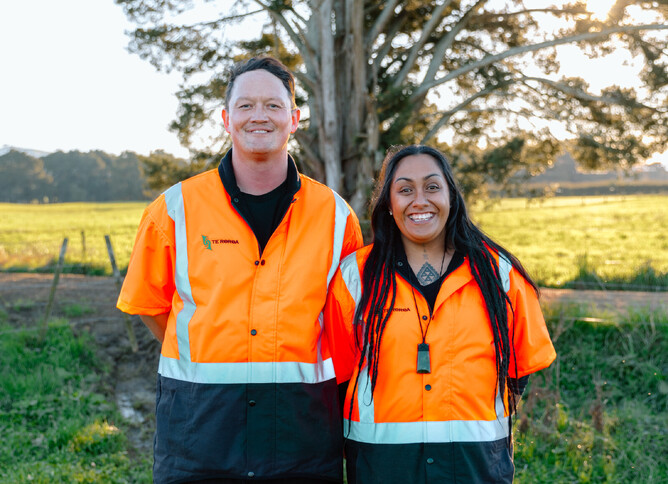
When LJ and Freda from Te Roroa joined the first Whakangungu wānanga led by Te Aho Tu Roa, they stepped into a space that went beyond learning. It was a reconnection.
The workshop was attended and facilitated by our team member Kiri Reihana, who supported the session as part of the Rere ki uta rere ki tai – Living Soil Project.
This wānanga, grounded in Te Ao Māori frameworks of understanding, explores how ancestral knowledge, language, and environment are woven together. For farmers, it opens new ways to think about soil, water, animals, and people as parts of one living system.
Learning Through Experience
The Whakangungu process follows the Pūnaha Akoako learning cycle, guiding participants through hands-on experiences that bring Mātauranga Māori to life. At Te Mauri Tau, a former deer farm now restored into an organic education institute, participants saw and felt the transformation that occurs when farming aligns with natural systems.
Freda described the experience as “deeply grounding,” helping her reconnect with pūrākau (storytelling) and Māori perspectives that felt more aligned and meaningful than conventional learning. Despite not being fluent in te reo Māori, she found the process healing and empowering, bridging cultural and spiritual understanding through participation.
Seeing the Land Differently
One of the most powerful moments came when wetlands were described as the kidneys of Papatūānuku. This simple yet profound analogy reshaped how participants viewed the environment as a living body that filters, heals, and sustains. It is a perspective that can inspire real shifts in how we restore and manage our landscapes.
Wairua, Kai, and Connection
For LJ, the wānanga filled both their wairua (spirit) and kete o te mātauranga (basket of knowledge). They reflected on how Te Ao Māori honours the balance of masculine and feminine energies within the atua, and how understanding these relationships can influence how we care for land and animals.
Kai, sourced directly from the whenua, brought another layer to the experience. It created a true farm-to-plate connection that nourished body, mind, and spirit. As LJ and Freda shared, the food itself became a form of learning, reminding us that everything begins and ends with the land.
A Vision for the Future
Both farmers agreed that kaupapa like Whakangungu have the power to transform not just farming but how Aotearoa connects with the land as a whole. These wānanga weave together science, Mātauranga Māori, and lived experience, showing that when we nurture connection, we nurture change.
The next step for the Rere ki uta rere ki tai – Living Soil Project is to continue developing entry-level tools and resources that bring these principles into practical use on farms. It is about creating pathways where language, culture, and land management can meet, helping farmers see themselves not only as producers but as kaitiaki of te taiao.